IonQ: The Full-Stack Government Quantum Powerhouse
How a CIA-Backed Startup Became the Only Vertically Integrated Quantum Platform on Earth — And Why That Matters for National Security

by Alex Trostorff | Quantum Point Partners
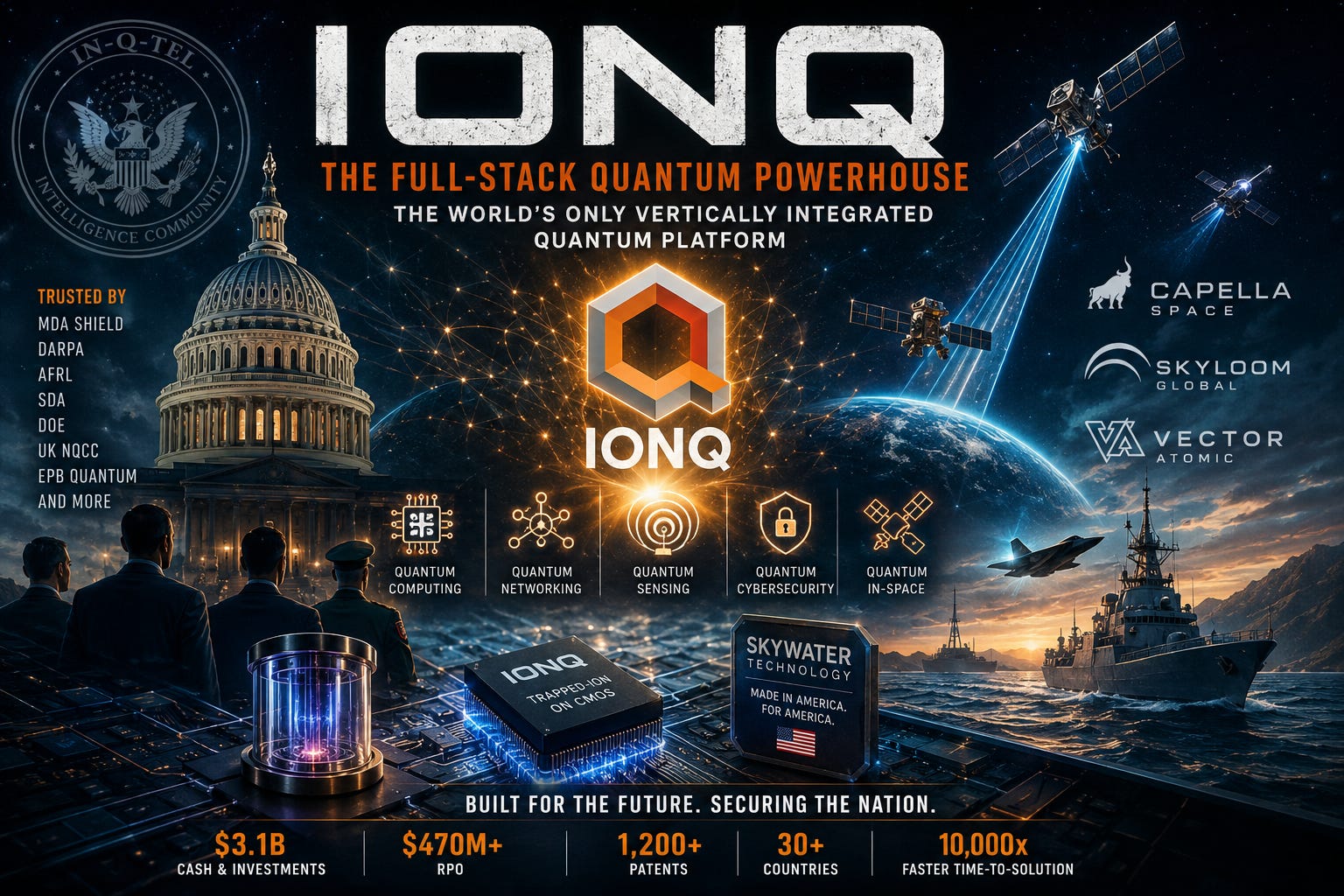
In 2013, a venture capital firm most people have never heard of wrote an early check into a quantum computing startup spun out of the University of Maryland and Duke University.
That firm was In-Q-Tel.
If you don't know In-Q-Tel, you should — because understanding who they are is understanding the connective tissue between Silicon Valley and Langley. In-Q-Tel is the strategic venture capital arm of the United States Intelligence Community. Founded in 1999, it exists for one purpose: to identify and fund the technologies that will become critical to national security before the rest of the market catches on. They don't invest for returns. They invest for capability.
Their track record is, frankly, absurd. Palantir — the intelligence platform now embedded across the DoD, IC, and allied governments — was an In-Q-Tel portfolio company. So was Planet Labs, the Earth observation constellation that provides daily global imagery to defense and intelligence customers worldwide. Rocket Lab, the only Western small-launch provider with a proven national security track record, took In-Q-Tel funding. MongoDB, now the database backbone of countless government systems. Recorded Future. Keyhole — which became Google Earth. The list goes on.
I've invested in many of these companies over the years. RKLB, PLTR, PL, DNA, WGS, MDB. The pattern is always the same: In-Q-Tel identifies a technology with dual-use potential, provides early validation, and then the commercial market catches up years later. By the time Wall Street notices, the government relationship is already deep, the technology is already proven, and the competitive moat is already dug.
IonQ was one of those bets.
And thirteen years later, that University of Maryland startup has become something no one else in the quantum industry can claim to be: the world's only full-stack quantum platform company, vertically integrated from chip fabrication to satellite communications, with the deepest government relationships in the sector.
This is the thesis. Let me walk you through it.
The Platform: Computing, Networking, Sensing, Security, and Space
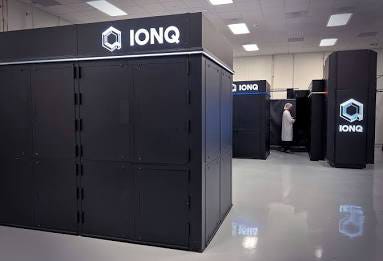
Most quantum companies do one thing. IonQ does five.
When CEO Niccolo de Masi talks about IonQ as "the world's only quantum platform company," he's not making a marketing claim. He's describing a structural reality that emerged from a $3B+ acquisition spree executed across 2025 and early 2026 — nine companies absorbed in roughly 18 months — that assembled capabilities no competitor can replicate without years of M&A and integration work.
Quantum Computing remains the core. IonQ's trapped-ion systems — Harmony, Aria, Forte, Forte Enterprise, and now the 100-qubit 5th-generation Tempo — represent five generations of commercial machines actually shipping to customers. The world-record 99.99% two-qubit gate fidelity isn't a lab result. It's a production specification. And the roadmap from here — 256 qubits in 2026, 10,000 in 2027, 200,000 by 2029, 2 million+ by 2030 — is no longer a physics problem. It's an engineering problem. And IonQ just bought the engineering.
Quantum Networking connects those computers together. Through ID Quantique (~$116M, controlling stake), Lightsynq, and Qubitekk ($22M), IonQ owns the full quantum networking stack: quantum key distribution, photonic interconnects, quantum memory nodes, and entangled photon sources. They've already deployed quantum networks in Switzerland, Poland, Romania, and Slovakia. They sold the first commercial quantum memory node into the Mid-Atlantic Regional Quantum Internet at the University of Maryland. DARPA selected them for the HARQ program — enabling an entirely new class of networked quantum computers.
Quantum Sensing arrived via Vector Atomic — atomic clocks, quantum gravimeters, and inertial navigation sensors. The defense applications are immediate: GPS-denied navigation for naval vessels using Earth's gravity fingerprint, ultra-precise synchronization for coordinating air assets, and gyroscopes for spacecraft orientation. These aren't future concepts. Vector Atomic brought over $200M in existing government contracts and 29 patents.
Quantum Cybersecurity is where the urgency is most acute. IonQ's CEO has publicly stated that Q-Day — the moment quantum computers can break current encryption — is just three years away. The DoD's own Critical Technology Area Roadmap agrees, estimating cryptographically relevant quantum computers could arrive as soon as 2028. Google's VP of Security has introduced a 2029 PQC migration deadline. IonQ, through ID Quantique's ~300-patent portfolio and their own cybersecurity stack, is deploying hardware and software quantum security solutions today — before encryption breaks.
Quantum In-Space is the layer most investors miss. This is where Capella Space and Skyloom Global come in, and it's where the defense thesis gets truly differentiated.
The Acquisitions That Changed Everything
Oxford Ionics — $1.075B — The Physics Unlock
If you understand one acquisition, understand this one.
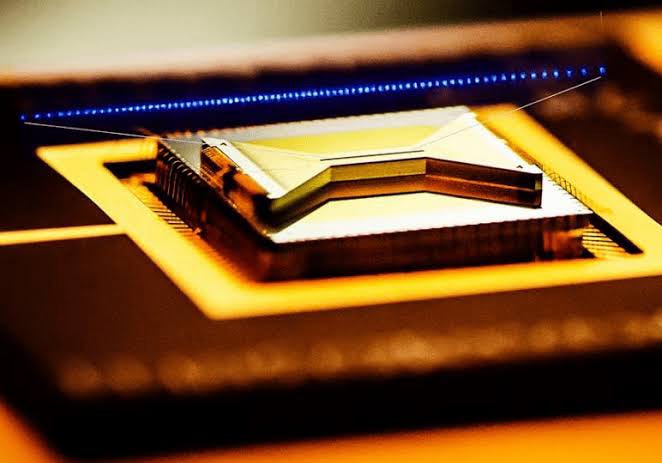
Oxford Ionics solved the fundamental scaling problem for trapped-ion quantum computing: how to control ions with electronics on a standard silicon die, instead of lasers. IonQ COO/CFO Inder Singh has been blunt about the limitation of lasers — they're too big, too expensive, too much maintenance, too much downtime. Tempo, the 100-qubit 5th-gen machine, is officially IonQ's last laser machine.
What replaces lasers: ion traps fabricated on mature CMOS nodes — 128nm, possibly smaller — the same fully depreciated semiconductor processes that built the modern chip industry. No 3nm. No 2nm. Ever. Thirty years of AMD, NVIDIA, and the entire semiconductor supply chain underneath.
Chris Ballance, Oxford Ionics co-founder and now IonQ's President of Quantum Computing, summarized it in one sentence: "Physics is a sunk cost. What matters is engineering."
This is the unlock that makes the SkyWater foundry play possible. Without Oxford Ionics, ion traps stay in the lab.
SkyWater Technology — $1.8B — The Foundry
With Oxford Ionics' technology in hand, IonQ needed a foundry. They tried overseas first. Singh told the story publicly at JP Morgan TMT: foreign foundries were amazed by the projected volume but couldn't justify the quantum capex. One foundry in Stockholm asked for revenue share. Singh's reply: "Over my dead body."
So IonQ pivoted to the only play that made strategic sense: a US foundry with the highest level of military security.
SkyWater Technology is a DMEA-accredited Category 1A Trusted Foundry — the highest DoD certification available. Facilities in Minnesota, Florida, and Texas become Regional Quantum Production Hubs. The supply chain runs >99% through the US and allies. Zero PRC reliance. Zero embedded malware risk. Clear line of sight on every engineer.
The deal: $1.8B ($15 cash + $20 stock per share). FTC Second Request cleared April 2026. SKYT shareholders approved May 8, 2026. Closing imminent.
What this means in practice: design-to-production cycles compressed from nine months to two months. First ion trap samples from SkyWater are already beating critical quality metrics for the 256-qubit chip. IonQ is starting its entire chip roadmap in the SkyWater foundry.
This is the first vertically integrated quantum manufacturer on Earth. No one else has this.
Capella Space — ~$425M — Eyes From Space
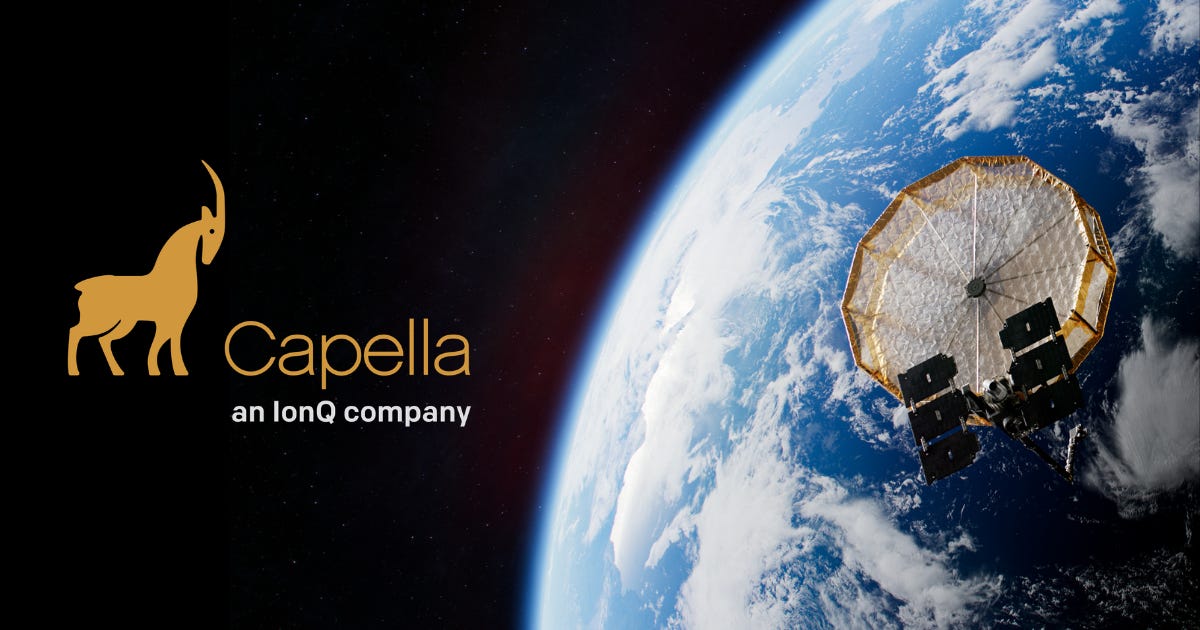
Capella operates a constellation of synthetic aperture radar (SAR) satellites — the only kind of Earth observation that works through clouds, darkness, smoke, and adverse weather. Day or night, any condition, Capella delivers high-resolution imagery.
For defense and intelligence, SAR is irreplaceable. Missile tracking and battlespace awareness for MDA SHIELD integration. Change detection for critical infrastructure monitoring. Maritime domain awareness — vessel tracking through any conditions. Disaster response. Border security.
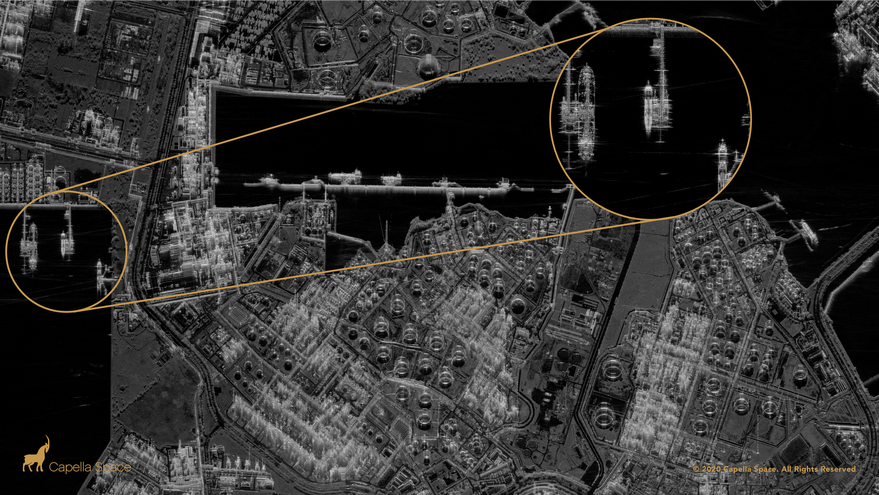
The connection to IonQ's quantum computing core is direct: quantum-enhanced processing enables faster analysis of SAR imagery at scale. And Capella's data downlink problem — getting imagery from orbit to ground stations fast enough to be actionable — connects directly to the next acquisition.
Leslie Kershaw, now IonQ's CISO, came from the Capella subsidiary. She previously served as Cyber Technical Director for Space DELTA 6 in the US Space Force. The talent follows the capability.
Skyloom Global — Space-Based Optical Communications
Skyloom builds satellite-to-ground and satellite-to-satellite laser communication systems. Roughly 20 optical satellite payloads already in low Earth orbit. This is the "fiberless internet" — ultra-high-bandwidth communications without terrestrial infrastructure.
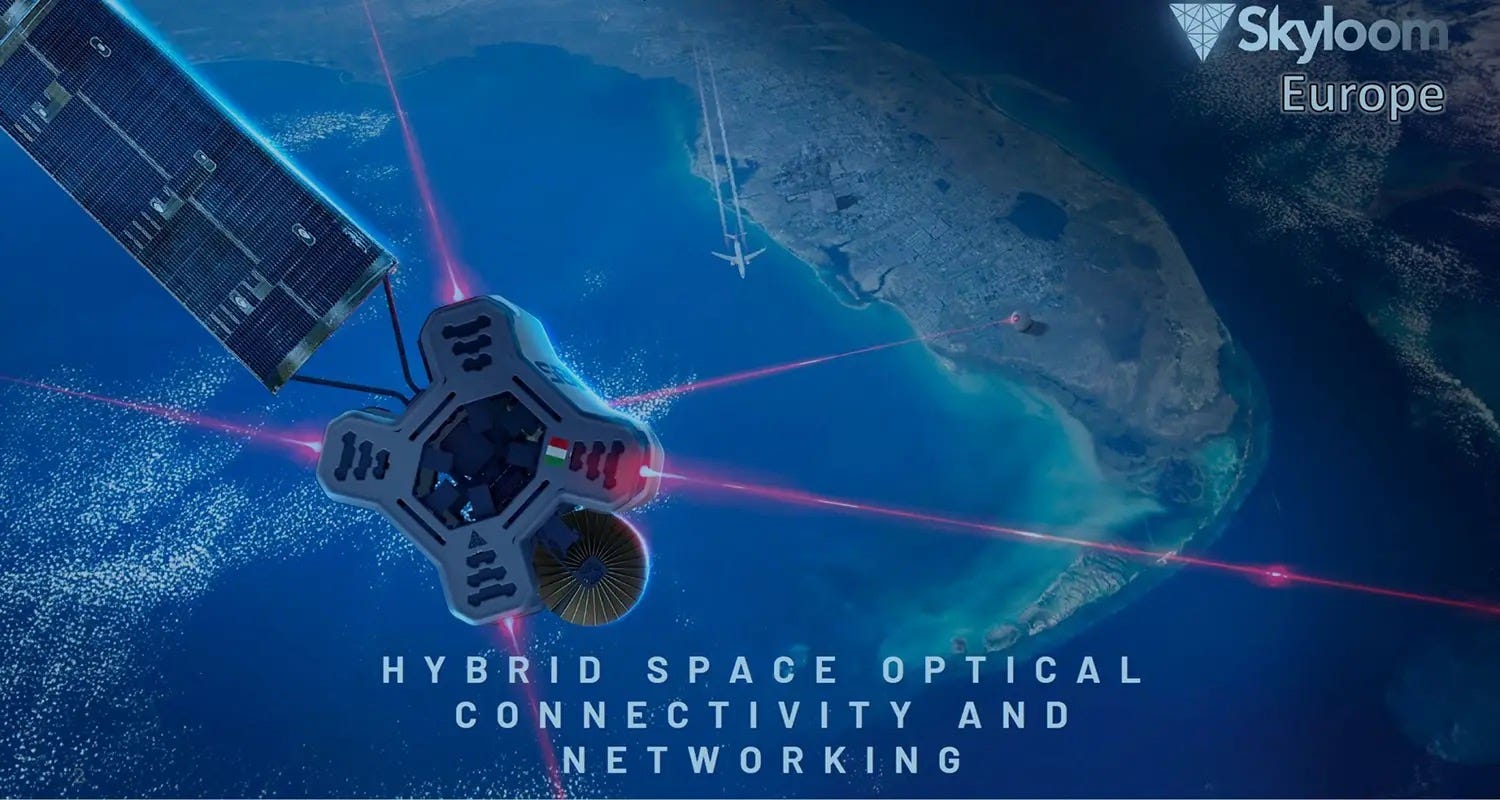
The defense integration is elegant: Skyloom's optical links provide real-time data downlink from Capella's SAR satellites. Secure comms for classified operations. Resilient links for GPS-denied environments. And critically, the optical architecture enables distribution of entangled photons through space — the physical layer of the future quantum internet.
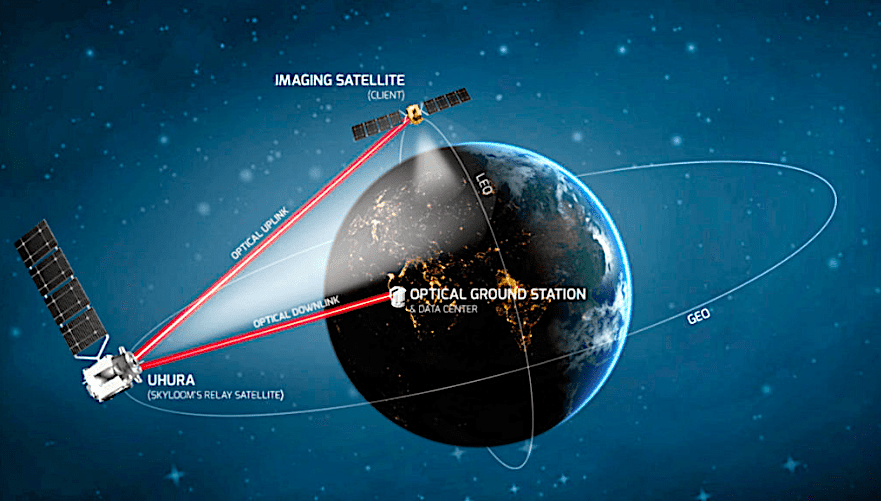
Acquired January 26, 2026 — completing IonQ's ground-to-space communications stack.
The Sensing Triad
Capella + Skyloom + Vector Atomic. SAR imagery + optical space communications + atomic clocks and quantum navigation. Together, they form IonQ's Space and Defense Sensing Triad — a combination no other quantum company possesses and no defense prime has assembled.
IonQ's own official investor presentation now shows the integrated platform operating across four domains: Space (quantum ground and space-to-ground networks), Air (PNT for GPS-denied environments), Land (quantum-encrypted networks and fast computation), and Sea (ultra-stable atomic clocks, GPS-free navigation, geophysical monitoring).
This isn't a slide deck aspiration. These are fielded capabilities from acquired companies with existing government contracts.
The Government Relationships
In-Q-Tel to MDA SHIELD: The Arc
From that initial In-Q-Tel investment to today, the arc of IonQ's government relationship has followed the classic pattern: intelligence community validation → defense research partnerships → major contract vehicles → executive talent acquisition from the highest levels of government.
MDA SHIELD IDIQ — $151 billion ceiling. Missile Defense Agency. IonQ is among eligible contractors for future task orders covering quantum computing, networking, sensing, and security. This isn't a single contract — it's a contract vehicle that positions IonQ to compete for task orders across the full spectrum of missile defense quantum applications, leveraging Capella for SAR imagery, Skyloom for optical comms, and Vector Atomic for precision timing.
AFRL — $100M+ in enterprise quantum networking deals. The Air Force Research Laboratory has been a sustained customer.
DARPA — Selected for Phase B of the Quantum Benchmarking Initiative. Hardware award for the HARQ program. These aren't small-business set-asides. These are competitive selections based on demonstrated capability.
SDA HALO Europa Award — Selected to advance next-generation secure space communications for the Space Development Agency.
UK National Quantum Computing Centre — Strengthening the UK's national quantum research capability.
US Department of Energy — MoU to advance quantum technologies in space.
EPB Quantum — First commercial US quantum computing and networking hub, in Chattanooga, Tennessee.
The Hires That Tell the Story
When you want to understand a company's real government positioning, don't read the press releases. Read the org chart.
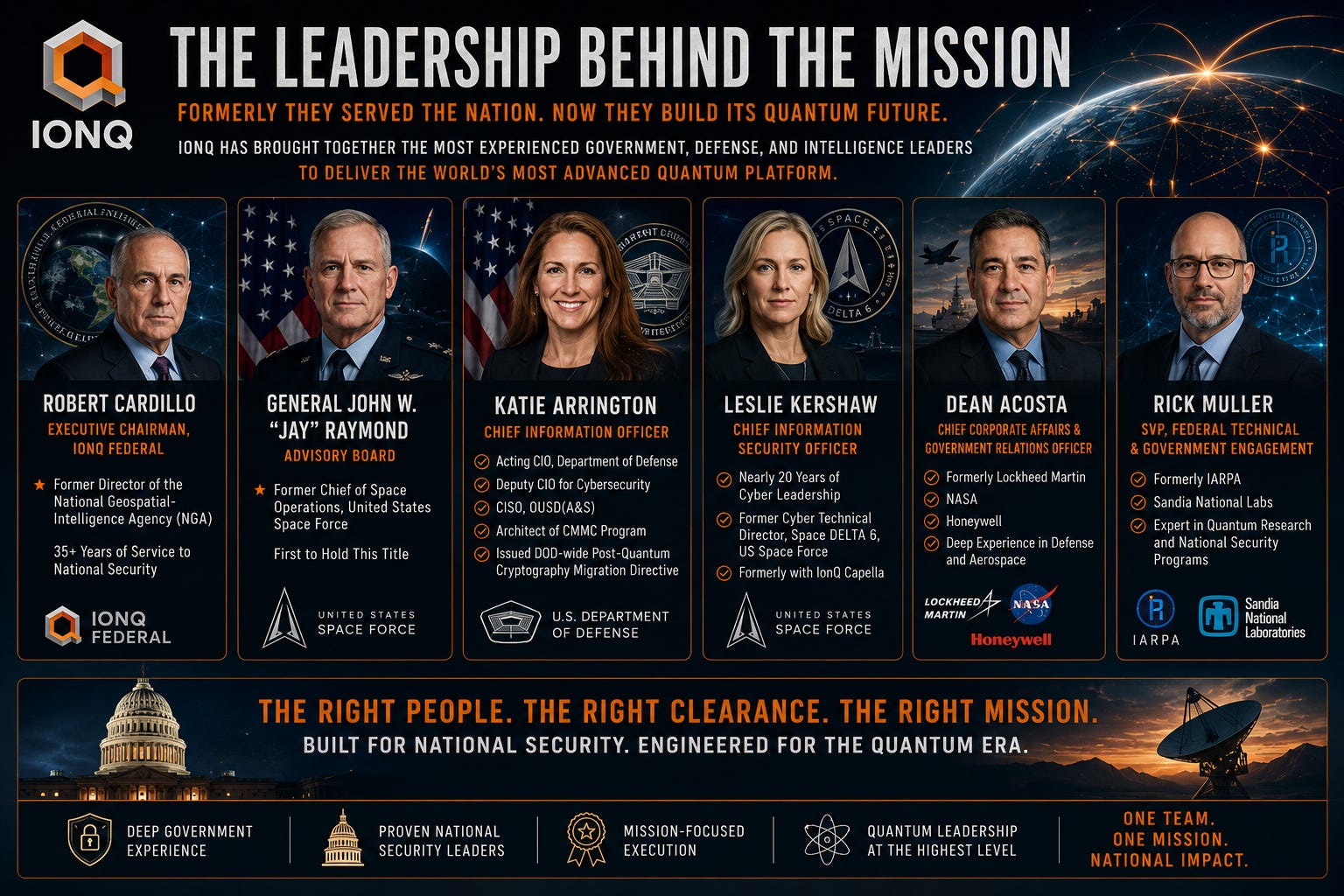
Robert Cardillo — Executive Chairman, IonQ Federal. Former Director of the National Geospatial-Intelligence Agency (NGA). The NGA is the IC agency responsible for geospatial intelligence — exactly the domain where Capella's SAR imagery operates. Cardillo didn't join IonQ to collect a board fee. He joined because the platform maps to his life's work.
General John W. "Jay" Raymond — Advisory Board. Former Chief of Space Operations, United States Air Force and United States Space Force. The first person to ever hold that title. The man who stood up the Space Force now advises the company that owns Capella Space and Skyloom Global.
Katie Arrington — Chief Information Officer. Started January 19, 2026. Her resume reads like a roadmap of DoD cybersecurity itself: Acting CIO of the Department of Defense (advising the Secretary on enterprise IT, cybersecurity, spectrum, and emerging technology policy). Deputy CIO for Cybersecurity (defense-wide oversight of cyber strategy, governance, and compliance). CISO for the Office of the Undersecretary of Defense for Acquisition and Sustainment. Architect of the Cybersecurity Maturity Model Certification (CMMC) program — literally the framework that every defense contractor must now comply with to bid on contracts. Before leaving government, she issued the DOD-wide post-quantum cryptography migration directive.
Read that last part again. The person who issued the Pentagon's order to migrate to post-quantum cryptography now works at the company building the post-quantum cryptography solutions.
Leslie Kershaw — CISO. Nearly 20 years of cyber leadership. Former Cyber Technical Director for Space DELTA 6, US Space Force — guiding cyber architecture across 13 globally dispersed locations. Previously with IonQ Capella. Reports to Arrington. Together they cover the full DoD cybersecurity spectrum.
Dean Acosta — Chief Corporate Affairs and Government Relations Officer. Lockheed Martin. NASA. Honeywell. The revolving door between defense primes and government is well-established, but Acosta's trajectory specifically into IonQ tells you where the gravity is shifting.
Rick Muller — SVP, Federal Technical and Government Engagement Lead. IARPA. Sandia National Labs. The intelligence community's quantum research pipeline, now inside IonQ.
This isn't a company that hired a couple of lobbyists. This is a company that absorbed the senior leadership of the agencies it now sells to.
The Use Cases: Where Quantum Meets the Real World
Defense and National Security
The defense applications span every domain.
Missile defense through the MDA SHIELD vehicle — quantum computing for trajectory optimization, Capella SAR for tracking, Skyloom for secure data relay. GPS-denied navigation for naval vessels, aircraft, and space vehicles through Vector Atomic's quantum sensors. Quantum-encrypted communications for classified operations. Post-quantum cryptography migration before Q-Day arrives. Critical infrastructure monitoring through change detection on SAR imagery.
IonQ's official materials now frame the platform across Space, Air, Land, and Sea — a joint-domain architecture that maps directly to how the DoD thinks about capability development.
Life Sciences and Drug Discovery
AstraZeneca achieved 20x faster time-to-solution for complex molecular simulations used in drug development — the best previously published quantum result. This isn't incremental improvement. This is the kind of speedup that changes the economics of pharmaceutical R&D.
Hyundai built the largest quantum computing battery chemistry model. CCRM (Centre for Commercialization of Regenerative Medicine) is exploring quantum applications in cell therapy and biologics manufacturing.
The pattern across these partnerships: buy a quantum computer, test it, then buy the next generation. QuantumBasel described this exact cycle. It's not a one-shot experiment — it's platform adoption.
Energy and Grid Optimization
Energy grid optimization using IonQ's novel QITE algorithm, developed with Oak Ridge National Lab. Next-generation battery chemistry modeling. EV charging network optimization. Reservoir simulation for oil and gas.
The power grid thesis connects directly to the broader macro story: capital flooding into the top of the AI stack while the grid remains underfunded. Quantum optimization of grid operations isn't a nice-to-have. It's an infrastructure necessity as AI datacenter demand explodes.
Finance
World's first large-scale portfolio optimization quantum algorithm on real S&P 500 data — improving portfolio quality and execution time over classical baselines in a production environment. Risk management. High-frequency trading optimization. Fraud detection. The world's largest financial institution deployed a 100Gbps IPSec VPN using IonQ's QKD technology.
Logistics
Einride, the autonomous electric freight company, used IonQ to optimize shipment allocation across active operations — achieving measurable increases in shipments delivered across all weekly schedules, representing significant revenue recovery at fleet scale. Route planning, fleet orchestration, cargo loading, and predictive maintenance are all quantum-addressable optimization problems.
Computer-Aided Engineering
Synopsys achieved up to 15% reduction in time-to-solution for large-scale structural models — including a Rolls-Royce jet engine — using quantum-enhanced graph partitioning, fully integrated into existing cloud workflows.
AI and Machine Learning
Up to 24% reduction in classification error using hybrid quantum-classical fine-tuning by adding quantum layers to pre-trained foundation models — breaking the exponential energy growth of classical fine-tuning workflows. This is the quantum-AI convergence thesis: quantum computing doesn't replace AI. It makes AI training dramatically more energy-efficient.
The Numbers
The financial trajectory tells the story of a company transitioning from research to platform:
2021: $2.1M revenue
2022: $11.1M
2023: $22.0M
2024: $43.1M
2025: $130.0M — first pure-play public quantum company to report over $100M in GAAP revenue
2026 guidance: $260-270M — doubling year-over-year at the midpoint
That's a 150% revenue CAGR based on the high end of guidance.
RPO (Remaining Performance Obligations): $470M — a record, representing over a year of forward visibility.
Cash and investments: $3.1B as of March 31, 2026. R&D spend: $300M+ annually, growing 120%+ year-over-year.
Approximately 1,500 employees. 1,200+ patent portfolio (610 issued, 514 pending, 131 exclusively licensed). 25+ offices across 10 countries. Solutions sold in 30+ countries across 5 continents.
And the operational metrics that matter: up to 10,000x faster time-to-solution demonstrated on enterprise-relevant workloads (third-party validated by Kearney). For a 2-million-physical-qubit system, IonQ's bill of materials cost is under $30M versus over $1B for superconducting architectures — a 30x+ advantage. Standard datacenter rack footprint. Wall socket power. No dilution refrigerators. No cryostats. No purpose-built facilities.
The Merchant Supplier Bombshell
At JP Morgan TMT in May 2026, Inder Singh said something the headlines missed:
IonQ is a merchant supplier. They sell components to other quantum computing companies. Those companies don't talk about it. IonQ doesn't talk about it. But some of those components are essential — their competitors' machines wouldn't work without IonQ's parts inside.
Let that sink in. The quantum machines built by IonQ's competitors — potentially including superconducting systems — depend on IonQ components to function.
De Masi's line — "There is no quantum industry. There is just IonQ" — stops being a CEO quote and starts being a supply chain fact.
The Anderon Validation
On May 21, 2026, the US Department of Commerce and IBM announced a Letter of Intent to build Anderon — "America's first purpose-built quantum foundry" — in Albany, New York. $1B proposed CHIPS award plus $1B from IBM. The US government took equity stakes in nine quantum companies: IBM, GlobalFoundries, Rigetti, D-Wave, Infleqtion, and four others.
IonQ was not on the list.
This isn't exclusion. It's prior execution.
Eight months before Anderon was announced, IonQ closed the Oxford Ionics acquisition. Heights Capital paid a 20% premium to invest $2B — no government equity, no dilution. SkyWater is being acquired with corporate cash, not CHIPS money. The entire IonQ supply chain was structured to not depend on federal subsidy.
The US government just wrote $2B in checks, in exchange for equity stakes, to do what IonQ already did with private capital.
IonQ rose 9% in premarket the day the program was announced. The market understood: not being in the program is the bullish signal.
The Thesis
IonQ is the only company in the world that owns the quantum computer, the foundry that fabricates the chips, the networking stack that connects the machines, the cybersecurity layer that protects them, the sensing platform that extends them into the physical world, and the space-based communications infrastructure that links it all from orbit.
The government relationships aren't bolt-on partnerships. They're structural — built over thirteen years from an In-Q-Tel seed investment to a $151B MDA SHIELD vehicle, staffed by the former Acting CIO of the Department of Defense, the former Director of NGA, and the first-ever Chief of Space Operations.
The thesis isn't reactive. It isn't aspirational. It's been documented, capitalized, manufactured, supplied, and staffed — in that order — over the past 18 months.
The quantum universe is being built. And IonQ is building it.
$IONQ
Alex Trostorff is the founder of Quantum Point Partners. This article reflects the author's analysis and investment thesis. The author holds a long position in IonQ. This is not financial advice.