America's Source: Why Westwater Resources (WWR) Is the Domestic Graphite Chokepoint
Coosa and Kellyton make Westwater the only US-scale natural-graphite anode project standing. The stock is beaten down, the offtake book got reset — and that's exactly why this is worth a hard look.

QUANTUM POINT PARTNERS — INVESTMENT RESEARCH
Disclosure & framing. I am long WWR. This is a sub-$1, ~$80M-market-cap development-stage company — a high-risk microcap. Nothing here is investment advice or a recommendation, and QPP is not a registered investment adviser. This is ecosystem research: structural-deficit and chokepoint analysis, not a substitute for your own diligence and position sizing. Read the risk section twice.
1. The chokepoint: a mineral the United States cannot buy domestically at all
Start with the number that should not exist in a serious economy: the United States imports 100% of its battery-grade natural graphite. Not most. All of it.
Graphite is the anode — roughly half of every lithium-ion cell by weight, the single largest material input in the battery, and a designated US critical mineral. And the supply chain behind it is the most concentrated in the entire battery complex. China controls on the order of 78% of natural graphite mining and over 90% of refined, spherical, battery-grade graphite (CSPG) — a tighter grip than it holds on rare earths. The reference point is BTR New Material: the single largest graphite anode producer on earth, supplier to CATL, LG, and Samsung. Any reshoring of anode material, by definition, has to displace BTR.
Beijing made the leverage explicit with December 2023 export licensing on natural flake and spherical graphite. Washington answered the only way it can on a multi-year lag: anti-dumping duties on Chinese anode material that now run around 220%, plus graphite's critical-mineral designation, IRA domestic-content rules, and DOE/EXIM funding lines aimed squarely at building a US supply chain that does not currently exist.
That's the setup. A material the country runs entirely on, controlled almost entirely by a strategic rival, with policy machinery now actively paying for a domestic alternative. The question isn't whether the US wants domestic graphite. It's who can actually produce it. The honest answer right now is: almost no one — which is where Westwater comes in.
2. Why WWR is the domestic source: Coosa + Kellyton, mine-to-market
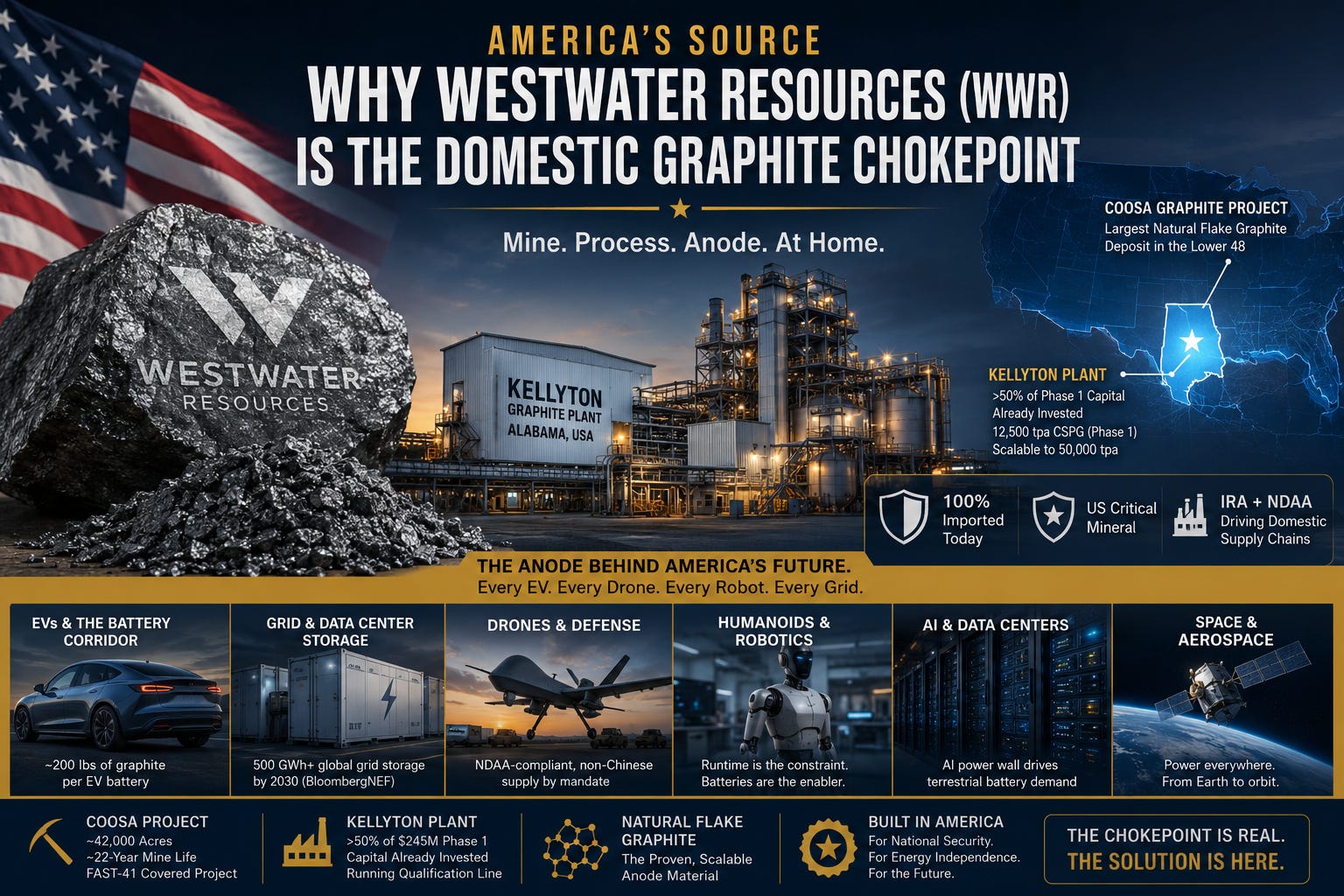
Westwater isn't a slide deck with a TAM chart. It's two physical assets in Alabama, 30 miles apart, that together form the only US-scale, vertically integrated natural-graphite-to-anode platform in the country.
Coosa is the upstream. It's the largest natural flake graphite deposit in the contiguous United States — ~42,000 acres of mineral rights, a 2023 Initial Assessment supporting a ~22-year mine life, and FAST-41 "covered project" status, the same expedited federal permitting track used for critical energy infrastructure. (One honest footnote for rigor: Graphite One's Graphite Creek in Alaska is a larger US deposit overall — but it sits in remote Alaska and is earlier-stage. Coosa is the largest in the lower 48, and it's paired with a built plant.)
Kellyton is the downstream, and it's the part the market keeps underweighting. This is a real, physical processing facility — more than 50% of the ~$245M Phase 1 capital (~$130M) already in the ground, buildings up, equipment placed. Phase 1 is designed for 12,500 metric tons per year of CSPG, scaling toward 50,000 mtpa across phases. Westwater has a patented purification process, a qualification line already running 1-ton batches, and has produced sample material that customers can actually test.
This is the line that matters in a sector full of vaporware: Westwater has buildings, a running qualification line, and product to qualify. Most of the "domestic graphite" universe is PowerPoint and permits. Westwater is concrete, steel, and CSPG. That distinction — physical readiness versus pipeline dreams — is the entire reason this name belongs in a different bucket than its peers.
3. Demand: graphite is the common denominator under everything we cover
The bull case is not "EVs." It's that graphite anodes sit under nearly every electrified, autonomous, and AI-adjacent demand vector in the QPP universe at once. Batteries are the connective tissue; graphite is the anode in (almost) all of them.
EVs and the battery corridor. Still the kilotonne anchor. An EV carries roughly 200 lbs of battery-grade graphite, and Kellyton sits in the Southeast battery corridor next to GM's Ultium JV (with LG), Ford's BlueOval SK, Tesla, and the Korean cell base (LG, Samsung SDI, SK On, Panasonic) plus CATL/BYD globally. IRA domestic-content rules push every one of these toward US-sourced anode material that, today, doesn't exist at scale.
Grid and data-center storage (BESS) — the fastest-growing leg. This is the one most people miss. BloombergNEF has the global grid-storage market crossing 500 GWh/year by 2030 — a ~10x expansion — and US grid BESS already tripled off its 2022 base. Every one of those Fluence (FLNC) Gridstack racks, every Form Energy and ESS Tech long-duration install, runs on anode material. And the AI power wall is now a terrestrial battery story: data centers are pairing on-site storage with the grid (see Emerald AI's grid-orchestration play, Bloom Energy's on-site power) precisely because the grid can't keep up. The same compute crunch that has people lofting GPUs into orbit (Starcloud, now wired into Starlink via optical crosslinks) is, on the ground, a battery-demand event.
Drones, defense, and counter-UAS. Small UAS, loitering munitions, and HALE platforms all run on lithium cells — Amprius (AMPX) is building silicon-anode cells specifically for high-altitude long-endurance UAVs, and the broader defense-drone base (Anduril, Skydio, Shield AI in our Defense ecosystem) is a structural, sovereignty-coded demand leg. Defense buyers want NDAA-compliant, non-Chinese supply by mandate — the cleanest possible customer profile for a domestic producer.
Humanoids, robotics, and automation. Runtime is the hard constraint on every mobile robot. Figure AI, Tesla Optimus, Apptronik's Apollo, Agility's Digit, Unitree — every humanoid and every AMR is a battery on legs. As our Robotics & Embodied AI map puts it, robots are a demand vector, not a separate supply chain. They pull on the same anode.
Space — one piece, close to home. Yes, orbital data centers and satellites need power systems, and Starcloud's mesh is being built within Alabama's aerospace gravity. But be disciplined: orbital compute is largely battery-minimizing by design (continuous-sunlight orbits), space cells are a specialized low-volume market, and this is color for "AI broke power," not a graphite tonnage driver. The real demand lives on the ground.
4. The competitive field — and where Westwater honestly sits
A rigorous read names the competition. The domestic/allied anode field:
Syrah Resources (Vidalia, LA) — the honest benchmark. Syrah operates the only currently active US anode facility, fed by its Balama mine in Mozambique, DOE-backed. It's ahead of Westwater on operating status.
Nouveau Monde Graphite (NMG) — Quebec mine-to-anode, GM offtake, allied (FTA) jurisdiction; pre-revenue, financing/construction risk.
Graphite One (GPH) — Graphite Creek, Alaska: the largest US deposit, but remote and earlier-stage.
Synthetic alternatives — Novonix (NVX, Phillips 66-backed, Chattanooga) and Anovion (DOE-funded, Georgia) — a different production route entirely.
Where Westwater sits: it is the only US-scale natural graphite anode project with both a domestic deposit and a built domestic plant — but it is dev-stage and pre-production, behind Syrah on operating status, and dependent on closing financing. Don't oversell it as "the only domestic graphite." Sell it as what it is: the most physically advanced natural-flake, mine-to-market, lower-48 play, in a field where almost everyone else is either synthetic, foreign-fed, remote, or paper.
5. The Alabama gravity well
Here's the underappreciated structural tailwind, and it's about state-level gravity, not a commute. Alabama is consolidating into one of the country's densest national-security and aerospace clusters: Redstone Arsenal already anchors Army Aviation & Missile Command, the Missile Defense Agency, and NASA's Marshall Space Flight Center — and U.S. Space Command is now relocating there, with the permanent headquarters designated in 2025 and ~1,400 positions phasing in over the next several years.
Westwater is a domestic critical-minerals asset inside that state's industrial base and congressional delegation — the same delegation fighting to pull federal money and missions into Alabama. (To keep it accurate: Kellyton is in central Alabama, a couple hours from Huntsville — same ecosystem and same political gravity, not literally next door.) For a defense-coded domestic anode producer, that gravity is the real payoff: proximity to the procurement ecosystem and to the people who write the checks for "make it in America" critical-minerals programs. Which leads directly to the variable that actually decides this stock.
6. The offtake reset — handled honestly — and the add-point thesis
Let's deal with the elephant. Westwater lost two anchor offtakes in five months: Stellantis/FCA terminated in November 2025, and SK On terminated on March 31, 2026. That hurt, and the stock has been beaten down accordingly.
But understand why it matters, because the consensus reads it wrong. Offtakes for a project like this function less as near-term revenue and more as financing collateral — contracted volumes are what make a $245M project bankable to lenders. Losing them is a problem for the capital raise, not a referendum on demand. Demand for domestic anode isn't going anywhere; if anything the import-dependence and tariff wall make it stronger. (Management has said both former counterparties have expressed interest in re-papering agreements — unconfirmed, but worth tracking.)
Now the part I'm actually playing: the reset is what created the discount. With the stock sub-$1 and the market apparently not pricing the FAST-41 status or the IRA/NDAA-compliance optionality, the offtake overhang has produced a beaten-down entry on a genuine domestic-source asset. That's the add-point — if you believe two things: (1) the structural demand floor holds, and (2) the next chunk of capital comes in a form that doesn't gut existing holders. That second "if" is the whole ballgame.
7. The financing decision tree: what actually drives the re-rate
Westwater needs roughly $50M more to complete Phase 1, against ~$41.5M of cash at the end of Q1 2026 and a Q1 net loss of ~$4.7M, with initial production expected ~12 months after financing closes. How that $50M gets filled determines whether shareholders capture the re-rate or finance someone else's:
The equity-protective path: non-dilutive government and strategic capital — DOE Loan Programs, DPA Title III, the Office of Strategic Capital, EXIM's "Make More in America," or an OEM/defense offtake-linked prepayment. The template already exists in our own coverage: Lithium Americas pulled a $2.26B DOE conditional loan for Thacker Pass — the equivalent of Centrus for nuclear enrichment. That's what non-dilutive financing of a national-security domestic source looks like, and it's exactly the channel Alabama's gravity (Section 5) and FAST-41 status are built to access.
The dilutive path: filling the gap through the ATM or a structured/control private-equity package. This de-risks the company while handing much of the upside to whoever provides the capital, at a depressed price, ahead of existing common.
So the catalysts to watch aren't really "demand." They're: a DOE/DoD/EXIM financing announcement, a re-papered or new offtake (especially defense-coded), and FAST-41 permitting milestones. Read the source of the next dollar, not the headline.
8. Setup and bottom line
The numbers: ~125M shares, a ~$79M market cap (April 2026), a sub-$0.70 stock, ~$41.5M cash, a ~$50M Phase 1 gap, and 2023/24 feasibility studies projecting positive pre-tax economics (IRRs in the mid-20s to low-30s percent). H.C. Wainwright carries a Buy at a $1.75 target; Maxim a Buy at $2.
Strip away the noise and Westwater is a clean expression of one idea: a country that imports 100% of a material it cannot run a battery, a drone, a robot, or a grid without — and the most physically advanced domestic source of that material, trading at a microcap valuation because it lost two offtakes that were really financing collateral. That's an asymmetric, binary setup. The asset and the timing edge are real; the demand floor is real; the catastrophic-import-dependence backdrop is real. The risk is equally real and concentrated in one place: financing. Close it non-dilutively and this re-rates hard. Close it through the ATM and holders eat the dilution before the thesis pays. That's the bet, stated plainly.
Risks (read these)
Financing / going-concern risk. WWR needs ~$50M to finish Phase 1 and is pre-revenue. Failure to close — or closing via heavy dilution — is the dominant risk.
Offtake risk. Two anchor offtakes (Stellantis, SK On) terminated. Rebuilding the book is unproven.
Dilution. Sub-$1 microcap with a thin float; ATM/equity financing can materially dilute holders.
Substitution risk (longer-term). Silicon-dominant anodes (Sila, Group14, Amprius, Enovix) and synthetic graphite (Novonix, Anovion) could erode natural-graphite demand over time. Near term, silicon is blended ontographite (5–15%) and natural-graphite demand still grows — but size this risk on a multi-year horizon.
Execution / commodity / permitting. Plant ramp, Coosa mine permitting, and graphite price volatility all carry standard development-stage risk.
QPP — Confidential research for discussion. Long WWR. Not investment advice; QPP is not a registered investment adviser. Verify all figures against current SEC filings before acting.